Distraction is the road risk hiding in plain sight
Distraction is the road risk hiding in plain sight
Road Safety Week shines a light on different risks each year. This year, several road safety organisations are focusing on driver distraction and for fleet operators, it is a topic worth sitting with. Not because your drivers are not trying. Most are. But distraction is one of the harder risks to manage in a fleet context, and the reasons for that are worth understanding.
Drivers spend nearly 2 minutes of every hour interacting with their phones while driving.*
Phones are the most visible form of distraction on our roads and they remain a significant issue despite mobile phone detection cameras, substantial fines, and demerit points. But in a working fleet, distraction is broader than that. It is cognitive load building across a long shift. It is a message from dispatch landing at the wrong moment. It is a customer calling a driver directly for an ETA. It is the competing demands of a job that requires concentration on the road and responsiveness to the business at the same time.
Drivers often underestimate how tired they are, and overestimate their ability to keep going even though fatigue is a factor in around 1 in 5 fatal crashes.*
That complexity is part of what makes distraction so difficult to manage. Unlike speeding or harsh braking, it rarely shows up in standard telematics data, and relying on drivers to self-report is not straightforward either. In most cases, the driver is not fully aware of their distraction at the time.
The same is true of fatigue. Research consistently shows that drivers significantly underestimate their own level of drowsiness, and microsleep events (those brief, involuntary eye closures of 1.5 seconds or more) often go unnoticed by the person experiencing them. That gap between what is happening behind the wheel, what the driver is aware of, and what is visible to the fleet manager is where many fleets may be missing vital signs before more serious incidents occur.
In customer trials, 99.3% of driver behaviour events detected by EROAD Clarity Edge would have never been detected by standard dashcams or telematics.
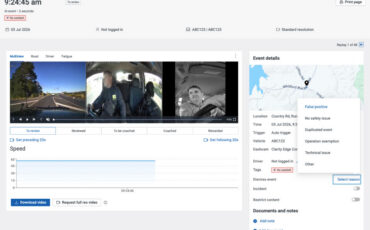
Getting better visibility of distraction starts with the technology in the cab. AI-enabled cameras can detect a range of distraction-related behaviours including phone use, fatigue, eyes-off-road events, and following distance, and flag them in real time with an in-cab alert, giving the driver the chance to correct before a situation develops.
In our AI camera trials, 99.3% of risky driver behaviours detected by AI cameras would have gone undetected by standard dashcams or telematics alone. Footage from these events, with automated tags to describe the behaviour, also gives fleet managers something concrete to work with.
A coaching conversation grounded in evidence, a specific moment, a specific trip, lands differently than a general reminder about safe driving. It is specific, it is fair, and it gives the driver something real to reflect on.
There are also simpler operational changes worth reviewing. In-cab messaging tools that lock while the vehicle is in motion mean drivers can only read and respond when they have safely stopped, a straightforward way to take one layer of distraction out of the equation entirely.
5 practical safety steps
If you are thinking about where to start, here are five practical steps worth taking this Road Safety Week, whether you have technology in place or not:
- Review how your drivers are contacted on the road. Is there a clear policy about when drivers should be reachable while driving? If not, writing one is a reasonable place to begin.
- Check whether your in-cab messaging requires the vehicle to be stationary. If drivers can access messages while moving, that is worth addressing.
- Look at your driver behaviour and/or dashcam data from the last month. What patterns are visible if you look across the fleet rather than at individual incidents?
- Have one evidence-based coaching conversation this week. One driver, one event, one honest conversation. The goal is awareness, not blame, and it sets the tone for how your team thinks about these issues.
- Ask your drivers what distracts them most. The people closest to the risk often have the clearest view of where it comes from. Their answers are worth knowing.
Repeated distraction can be a signal worth paying attention to. Drivers dealing with fatigue, stress, or pressures outside of work may struggle to stay focused regardless of policy or technology. The fleets that see the best outcomes tend to be the ones that treat safety data as the start of a conversation, not the end of one.
Distraction does not go away after Road Safety Week, and it is not a simple issue to resolve. But this is as good a moment as any to look at what your fleet can actually see, and close the gap on what it cannot.
Explore EROAD's safety solutions →