What are the latest HVNL changes?
What are the latest HVNL changes?
What do Fleet Managers and Operators Need to Know Now?
The Heavy Vehicle National Law (HVNL) continues to evolve and the recent changes represent some of the most significant updates to Australia’s heavy vehicle regulatory framework in recent years. For fleet managers and operators, understanding these amendments isn’t just about compliance – it’s about protecting your business, your drivers, and the broader public.
For the latest information and full details of the HVNL requirements, please refer to the National Heavy Vehicle Regulator (NHVR) website.
Background: Why the Changes?
The HVNL amendments stem from ongoing work by the National Heavy Vehicle Regulator (NHVR) and the government to strengthen the safety framework, aimed at reducing fatigue-related incidents, improving chain of responsibility (CoR) accountability and modernising compliance tools for vehicle fleets.
The updates reflect a clear regulatory direction: shared accountability across the entire supply chain – NOT just at the driver level. Here’s an overview of what changing.
1. What are the enhanced Chain of Responsibility (CoR) Obligations?
The changes reinforce and, in some cases, expand the duties placed on all parties in the supply chain including consignors, consignees, schedulers, loaders and employers – not just drivers and operators. This means:
- businesses can no longer treat CoR compliance as a tick-box exercise. The NHVR has made clear that executive officers of companies can be held personally liable if they fail to exercise due diligence
- documented safety management systems are no longer optional – they are a practical necessity to demonstrate compliance
- you need to be able to show that your organisation actively identifies and manages risks, rather than simply reacting to incidents
2. What are the Fatigue Management Reforms?
Fatigue continues to be a major contributing factor in serious heavy vehicle crashes in Australia. The updated provisions tighten requirements around work and rest hour recording, fatigue management accreditation and employer oversight obligations. This means:
- stricter requirements apply to how work and rest hours are recorded and verified
- operators using Basic Fatigue Management (BFM) or Advanced Fatigue Management (AFM) accreditation schemes should review their current accreditation status and ensure compliance with any updated conditions
- the burden on schedulers and employers to ensure drivers are not placed in situations where fatigue is a foreseeable risk has been strengthened
3. How are Electronic Work Diaries (EWDs) impacted?
The transition toward Electronic Work Diaries continues to accelerate. The changes include updated provisions relating to EWD approval, use and record-keeping obligations. This means:
- only NHVR-approved EWD systems can be used to satisfy record-keeping requirements
- there are updated obligations around data retention, accessibility and format for compliance purposes
- drivers must still be trained in the correct use of EWD systems — a malfunction or user error is not automatically an accepted defence
4. What updates have been made to Mass, Dimension and Loading?
Amendments to provisions governing vehicle mass, dimensions and load restraint introduce updated permit conditions and compliance assessment criteria. This means:
- some permit conditions and route approvals may have changed. Blanket assumptions that existing arrangements remain valid could expose your business to risk
- load restraint obligations under the Load Restraint Guide continue to be enforced with greater rigour, with liability extending up the supply chain to loaders and consignors
- overloading remains one of the most commonly detected breaches, with penalties and vehicle defect notices increasingly applied
The Stakes Are Real – what are the penalties for non-compliance?
The HVNL carries significant financial penalties for non-compliance and the changes do not soften the enforcement approach. Category 1 offences – those involving a serious risk to safety – can attract penalties of up to $300,000 for individuals and $3 million for corporations.
Importantly, the NHVR and enforcement agencies have signalled an increased focus on proactive compliance audits rather than purely reactive enforcement following incidents. That means your business could be assessed at any time, not only after something has gone wrong.
Don’t Wait for a Knock on the Door
The experience of operators who have faced NHVR enforcement action consistently highlights a key theme: proactive compliance is far less costly than reactive remediation. An investment now is significantly less disruptive and less costly than responding to a notice of non-compliance, a vehicle defect order, or worse, an incident investigation.
How can EROAD help you stay ahead of (or, catch up with) the HVNL changes?
Meeting the new HVNL requirements doesn’t have to mean more paperwork, more administration and more stress. EROAD provides the tools, data and visibility to put compliance on autopilot – so your fleet is protected before a regulator comes knocking.
Fatigue Management – Intervene before it’s too late
Fatigue remains the NHVR’s number one concern – and EROAD addresses it head on. Without real-time intervention tools, there is no way to act before an incident occurs.
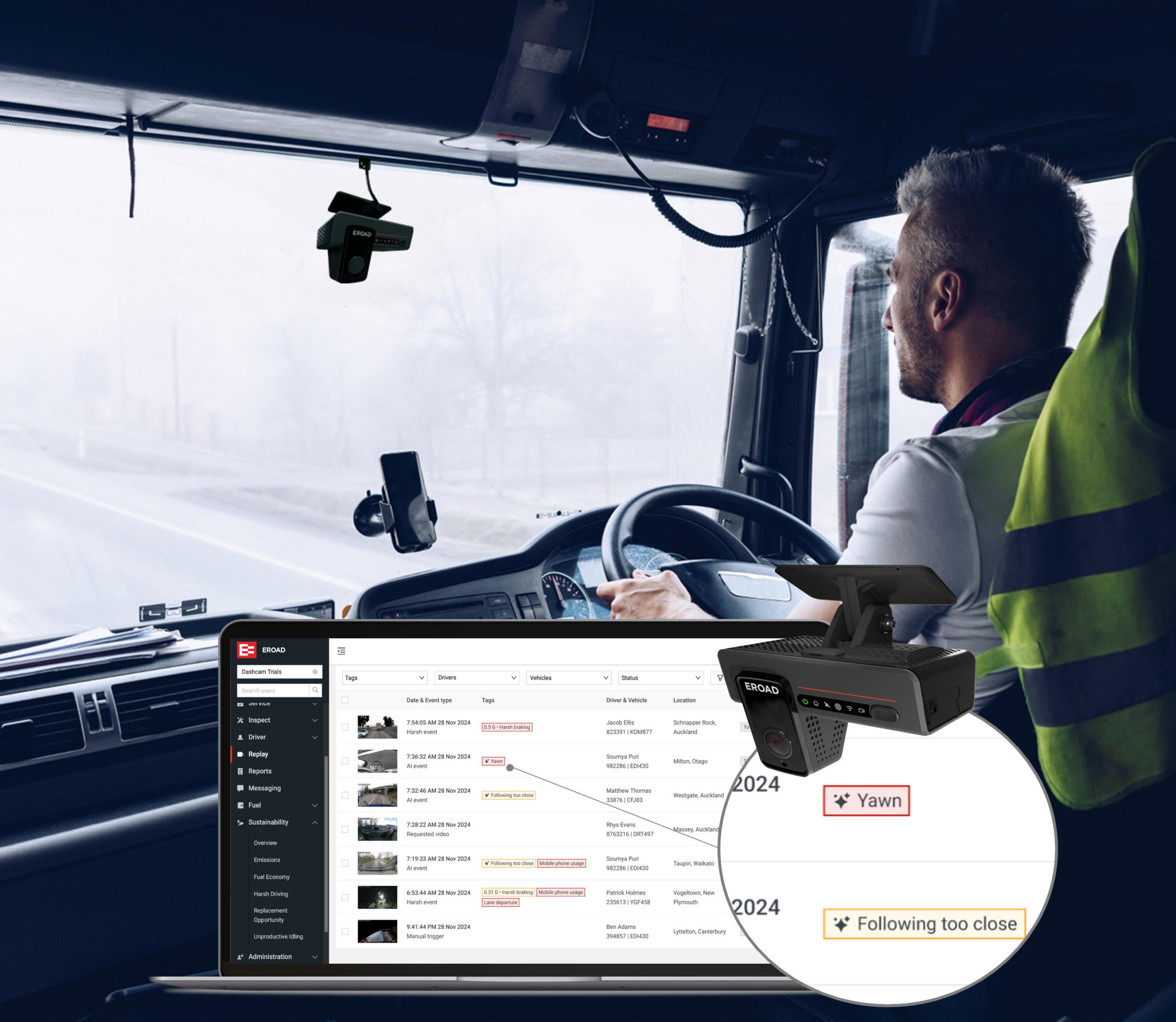
- AI fatigue detection monitors drivers in real time, identifying microsleep and drowsiness through facial tracking that works even through sunglasses
- In-cab voice alerts and seat shaker warnings activate the moment fatigue is detected, adding an additional layer of intervention for your highest-risk operating hours
- Optional 24/7 EROAD Monitored Service means trained operators are reviewing fatigue alerts around the clock and escalating directly to your management team by phone for immediate intervention
- Under Work Health and Safety (WHS) laws, Company Directors, Executives and Managers all carry significant responsibility to provide safe work environments – proactive fatigue management is no longer optional
Chain of Responsibility – Protect Yourself Up and Down the Supply Chain
Under the strengthened CoR obligations, you need to demonstrate your business actively manages risk. EROAD helps give you the evidence trail to do exactly that.
- AI-powered dashcams automatically detect and record safety events with timestamped video footage, uploaded automatically for coaching and compliance
- Driver behaviour is automatically recorded, scored and benchmarked – giving managers the evidence they need to have meaningful coaching conversations and build lasting safe habits
- Real-time speed and driver behaviour feedback in the vehicle helps to encourage safer driving in-the-moment
- Geofence-triggered messages can deliver important location-based safety warnings to drivers, such as low bridge ahead
- Crash and rollover detection triggers emergency alerts automatically, and a discrete panic button ensuring no driver is ever without a lifeline
- Extend coverage across mobile black spots with satellite connectivity, so you maintain visibility of drivers and support emergency response
- If you’ve got accountability beyond employees, EROAD Share lets you view subcontractor activity and reporting as well
When regulators or insurers ask what steps you took, you’ll have the data to prove it
Vehicle Standards and Maintenance – Stay Roadworthy and Inspection Ready
The updated HVNL places greater scrutiny on maintenance management systems. EROAD helps make this effortless.
- Registration expiry tracking and full vehicle service history sit alongside inspection records and defect management in one place – ready for roadside inspections and regulatory audits at any time
- The Inspect app replaces paper-based pre-trip and post-trip checklists with digital inspections, with defects automatically flagged and records stored and audit-ready
- Defects are automatically flagged and routed into Fleet Maintenance for scheduling and resolution – reducing downtime and eliminating spreadsheets
- CAN Bus engine health monitoring with configurable alert thresholds flags issues before they become compliance failures or safety risks
Talk to EROAD today